
Tungsten Carbide Grades (ISO K, M, P): Chart, WC Content & Applications Guide
Tungsten carbide grades chart covering ISO K, M, P series (K10, M20, P30), WC content, and applications. Low-cost custom manufacturer, MOQ 1 piece.
Tungsten carbide grades are essential for determining machining performance, wear resistance, and tool life across different industrial applications. Understanding the ISO classification system—including K, M, and P series grades such as K10, M20, and P30—helps engineers and buyers select the most suitable material for cast iron, stainless steel, and steel machining.
This page provides a comprehensive tungsten carbide grades chart, covering ISO K-series, M-series, and P-series grade equivalents across major manufacturers, along with WC content comparison and application guidance. Whether you are looking for finishing, general machining, or heavy-duty cutting solutions, this guide serves as a practical reference for carbide grade selection.
Email: [email protected] | WhatsApp: +86 186 3895 1317 | Request a Quote
Tungsten Carbide Grades K10, K15, K20, K30: ISO K-Series Grade Chart (2026)
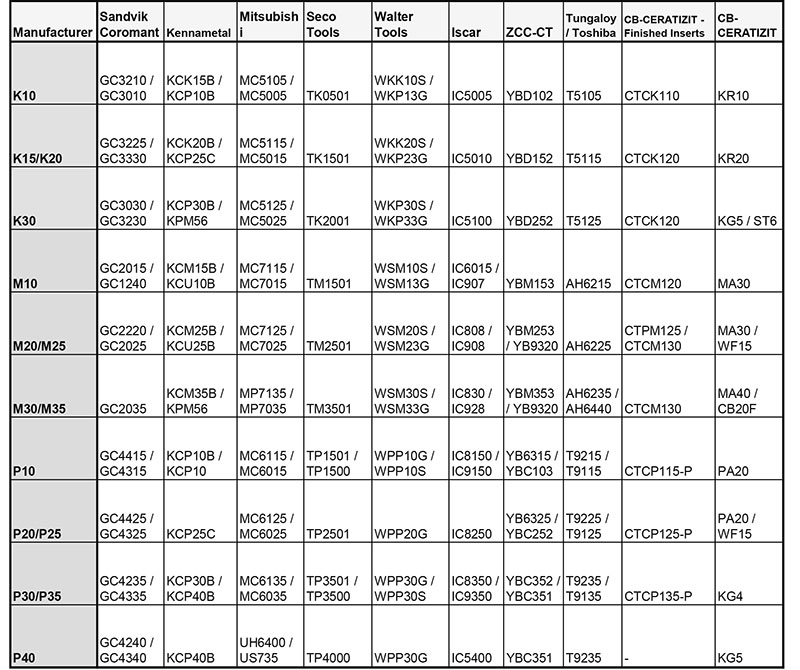
This tungsten carbide grade chart provides a cross-reference of ISO K-series grades, including K10, K15, K20, and K30, across major global manufacturers. These carbide grades are primarily designed for machining cast iron, ductile iron, and non-ferrous materials, with each grade optimized for different cutting speeds, wear resistance, and toughness requirements.
K10 grades are typically used for high-speed finishing of gray cast iron, offering excellent wear resistance. K15 and K20 grades provide a balanced combination of hardness and toughness for general machining of ductile iron and similar materials. K30 grades are designed for heavy cutting conditions, lower speeds, and applications involving higher mechanical loads such as compacted graphite iron.
Please note that equivalent grades may vary depending on coating type, substrate composition, and machining conditions. This chart is intended as a general reference for grade comparison and initial material selection.
| Manufacturer | K10 Gray Cast Iron / High-Speed Finishing |
K15 / K20 Ductile Iron / General Machining |
K30 Heavy Conditions / Low Speed / Compacted Graphite Iron |
|---|---|---|---|
| Sandvik Coromant | GC3210 / GC3010 | GC3225 / GC3330 | GC3030 / GC3230 |
| Kennametal | KCK15B / KCP10B | KCK20B / KCP25C | KCP30B / KPM56 |
| Mitsubishi Materials | MC5105 / MC5005 | MC5115 / MC5015 | MC5125 / MC5025 |
| Seco Tools | TK0501 | TK1501 | TK2001 |
| Walter Tools | WKK10S / WKP13G | WKK20S / WKP23G | WKP30S / WKP33G |
| Iscar | IC5005 | IC5010 | IC5100 |
| ZCC-CT | YBD102 | YBD152 | YBD252 |
| Tungaloy / Toshiba | T5105 | T5115 | T5125 |
| CB-CERATIZIT / Chunbao – Finished Inserts | CTCK110 | CTCK120 | CTCK120 |
| CB-CERATIZIT / Chunbao | KR10 (ultrafine-grain high-hardness substrate) | KR20 | KG5 / ST6 |
Tungsten Carbide Grades M10, M20, M25, M30, M35: ISO M-Series Grade Chart
This 2026 ISO M-series tungsten carbide grade chart compares common M10, M20, M25, M30, and M35 carbide grades across major global manufacturers. ISO M-series carbide grades are mainly used for stainless steel, cast steel, alloy steel, and difficult-to-machine materials where balanced wear resistance, toughness, and cutting stability are required.
M10 grades are typically used for continuous high-speed cutting and surface finishing. M20 and M25 grades are suitable for general machining and light interrupted cutting. M30 and M35 grades are designed for low-speed machining, heavy depth of cut, roughing, and more demanding cutting conditions.
| Manufacturer | M10 Continuous High-Speed Cutting / Finishing |
M20 / M25 General Machining / Light Interrupted Cutting |
M30 / M35 Low-Speed Heavy Cutting / Roughing |
|---|---|---|---|
| Sandvik Coromant | GC2015 / GC1240 | GC2220 / GC2025 | GC2035 |
| Kennametal | KCM15B / KCU10B (PVD) | KCM25B / KCU25B (PVD) | KCM35B / KPM56 |
| Mitsubishi Materials | MC7115 / MC7015 | MC7125 / MC7025 | MP7135 / MP7035 (PVD) |
| Seco Tools | TM1501 | TM2501 | TM3501 |
| Walter Tools | WSM10S / WSM13G | WSM20S / WSM23G | WSM30S / WSM33G |
| Iscar | IC6015 / IC907 | IC808 / IC908 | IC830 / IC928 |
| ZCC-CT | YBM153 | YBM253 / YB9320 | YBM353 / YB9320 |
| Tungaloy / Toshiba | AH6215 | AH6225 | AH6235 / AH6440 |
| CB-CERATIZIT / Chunbao – Finished Inserts | CTCM120 (CVD wear-resistant grade) | CTPM125 (PVD tough grade) / CTCM130 | CTCM130 |
| CB-CERATIZIT / Chunbao | MA30 (medium-grain substrate) | MA30 / WF15 | MA40 / CB20F (ultra-high-cobalt substrate) |
Tungsten Carbide Grades P10, P20, P25, P30, P35, P40: ISO P-Series Grade Chart
This 2026 ISO P-series tungsten carbide grade chart compares common P10, P20, P25, P30, P35, and P40 carbide grades across major global cutting tool manufacturers. ISO P-series carbide grades are mainly used for steel machining, including carbon steel, alloy steel, and cast steel applications.
P10 grades are typically selected for continuous cutting and high-speed finishing. P20 and P25 grades are suitable for general steel machining and light interrupted cutting. P30 and P35 grades are used for heavy interrupted cutting and roughing, while P40 grades are designed for low-speed, high-impact interrupted machining conditions.
| Manufacturer | P10 Continuous Cutting / High-Speed Finishing |
P20 / P25 General Machining / Light Interrupted Cutting |
P30 / P35 Heavy Interrupted Cutting / Roughing |
P40 Low-Speed High-Impact Interrupted Cutting |
|---|---|---|---|---|
| Sandvik Coromant | GC4415 / GC4315 | GC4425 / GC4325 | GC4235 / GC4335 | GC4240 / GC4340 |
| Kennametal | KCP10B / KCP10 | KCP25C (KENGold) | KCP30B / KCP40B | KCP40B |
| Mitsubishi Materials | MC6115 / MC6015 | MC6125 / MC6025 | MC6135 / MC6035 | UH6400 / US735 |
| Seco Tools | TP1501 / TP1500 | TP2501 (Duratomic) | TP3501 / TP3500 | TP4000 |
| Walter Tools | WPP10G / WPP10S | WPP20G (Tiger·tec Gold) | WPP30G / WPP30S | WPP30G |
| Iscar | IC8150 / IC9150 | IC8250 (SUMO TEC) | IC8350 / IC9350 | IC5400 |
| ZCC-CT | YB6315 / YBC103 | YB6325 / YBC252 | YBC352 / YBC351 | YBC351 |
| Tungaloy / Toshiba | T9215 / T9115 | T9225 / T9125 | T9235 / T9135 | T9235 |
| CB-CERATIZIT / Chunbao – Finished Inserts | CTCP115-P | CTCP125-P (Dragonskin) | CTCP135-P | – |
| CB-CERATIZIT / Chunbao | PA20 (fine-grain hard substrate) | PA20 / WF15 | KG4 (medium-coarse grain tough substrate) | KG5 |

ISO Tungsten Carbide Grades WC Content Chart: Composition Reference
This table shows the typical tungsten carbide (WC) content range for ISO carbide grades, including K, M, and P series. The WC content directly affects hardness, wear resistance, and toughness of the carbide material, making it a key factor in grade selection for different machining applications.
In general, higher WC content provides improved wear resistance and hardness, while lower WC content (with higher cobalt binder content) enhances toughness and impact resistance. Understanding the WC percentage helps engineers and buyers select the most suitable carbide grade for cutting conditions and workpiece materials.
| ISO Grade | Typical WC Content (%) | Binder (Co) Content (%) | Grain Size | Typical Properties |
|---|---|---|---|---|
| K10 | 94 – 96 | 4 – 6 | Ultrafine / Fine | High hardness, excellent wear resistance, low toughness |
| K20 | 92 – 94 | 6 – 8 | Fine | Balanced wear resistance and toughness |
| K30 | 88 – 92 | 8 – 12 | Medium | Higher toughness, suitable for heavy load |
| M10 | 93 – 95 | 5 – 7 | Fine | Good wear resistance for stainless steel finishing |
| M20 | 91 – 93 | 7 – 9 | Fine / Medium | General-purpose machining, balanced performance |
| M30 | 88 – 91 | 9 – 12 | Medium | Improved toughness for interrupted cutting |
| P10 | 92 – 94 | 6 – 8 | Fine | High-speed steel finishing, stable cutting |
| P20 | 90 – 92 | 8 – 10 | Medium | General steel machining |
| P30 | 87 – 90 | 10 – 13 | Medium / Coarse | High toughness, heavy cutting conditions |
| P40 | 85 – 88 | 12 – 15 | Coarse | Maximum toughness, impact-resistant applications |
Summary and Disclaimer
The tungsten carbide grade comparisons provided above are intended as a general reference to help understand the approximate equivalence between ISO grades such as K10, K20, M20, and P30 across different manufacturers. Due to variations in carbide composition, coating technology, and application-specific optimization, exact performance may differ between brands even when grades appear similar.
All brand names, grade designations, and data presented are collected from publicly available sources, including manufacturer catalogs and technical documents. This information is provided for reference purposes only and does not represent any official endorsement or direct equivalence between brands.
We specialize in custom manufacturing of tungsten carbide components, including carbide nozzles, dies, bushings, rollers, and precision wear parts. Our engineering team can recommend suitable carbide grades based on your application requirements, including material type, tolerance, and working conditions.
If you have any project requirements, please feel free to contact us by email at [email protected]. We welcome your drawings and technical details for quotation and engineering support.
👉
Download Tungsten Carbide Grades Chart PDF (ISO K, M, P)
Related articles:
Recommended Products


Still unsure which tungsten carbide grade fits your application? Our engineers will recommend the most suitable solution based on your requirements. MOQ: 1 piece, with competitive low-cost pricing.


